
Description
One founder built his business to $700K and felt stuck. Not financially — personally. He owned it on paper. He was operating it in practice. A year after working through what this series addresses — handing client relationships over one at a time, moving decisions down to the team, stopping being the answer to every question — he took three weeks away. Revenue held. The team handled everything. He came back to a business that had not missed him.
That was the first time he felt like an owner. Not when the revenue milestone hit. When the business ran without him for three weeks and nothing broke.
That is what this series is building toward. Four phases. Four assets. One shift.
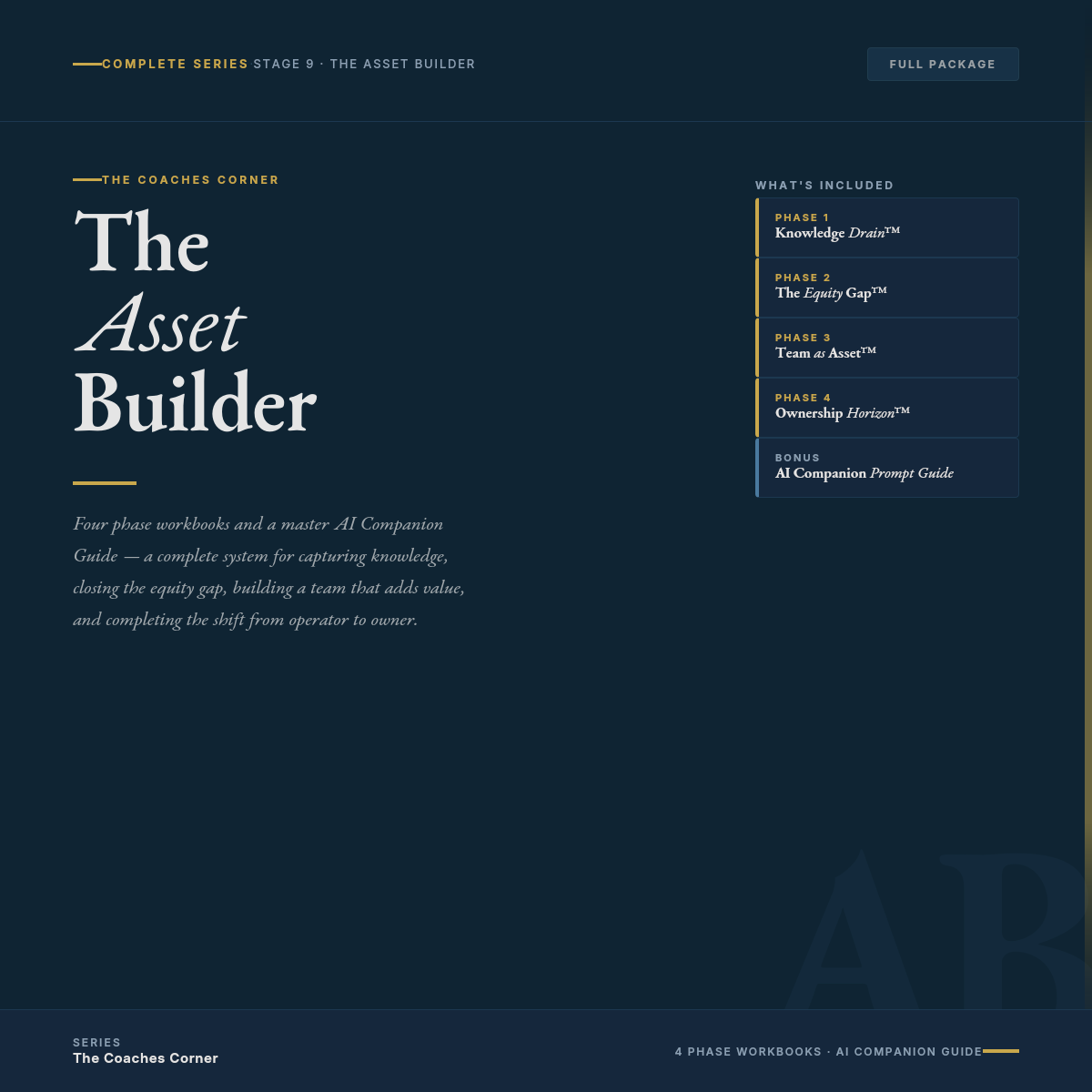
Phase 1 — Knowledge Drain™ What lives in heads is not owned by the business. A business reached $400K with three people who carried everything — the clients, the processes, the judgment calls. Two left within six months. The replacements were capable and trained. The judgment did not transfer. The final cost: $15,000 and four months of disruption. That is not a people problem. It is a knowledge-ownership problem — and it is entirely fixable, one captured process at a time. Phase 1 identifies the four signs a Knowledge Drain is already happening, maps where critical knowledge currently lives, and executes the first capture: one repeating situation, written down, owned by the business.
Phase 2 — Equity Gap™ Revenue is a measure of performance. Equity is a measure of independence. A business that runs on the owner has consistent effort — but not an asset. The Equity Gap is the distance between what the business earns and what it would be worth if the owner stepped back. One founder explored an exit after a decade of building to $600K. The first offer came in far lower than expected. The buyer’s explanation was precise: “Without you, there is no business.” He spent 18 months closing the gap. The next offer was 2.4× higher. Same revenue. Very different business. Phase 2 makes the gap visible and starts closing it — one owner-dependent activity at a time.
Phase 3 — Team as Asset™ A strong team and a valuable team are not the same thing. Eight people, five years, $750K in revenue — and then two key people left in the same month. Deadlines slipped, clients escalated, one paused their contract. The team had been a single point of failure dressed up as a team. The distinction that matters is not how much the team can do — it is whether the team distributes knowledge, decisions, and client relationships, or concentrates them. Phase 3 scores the team against three specific markers, maps the fragility, and starts building a structure that does not break when people change.
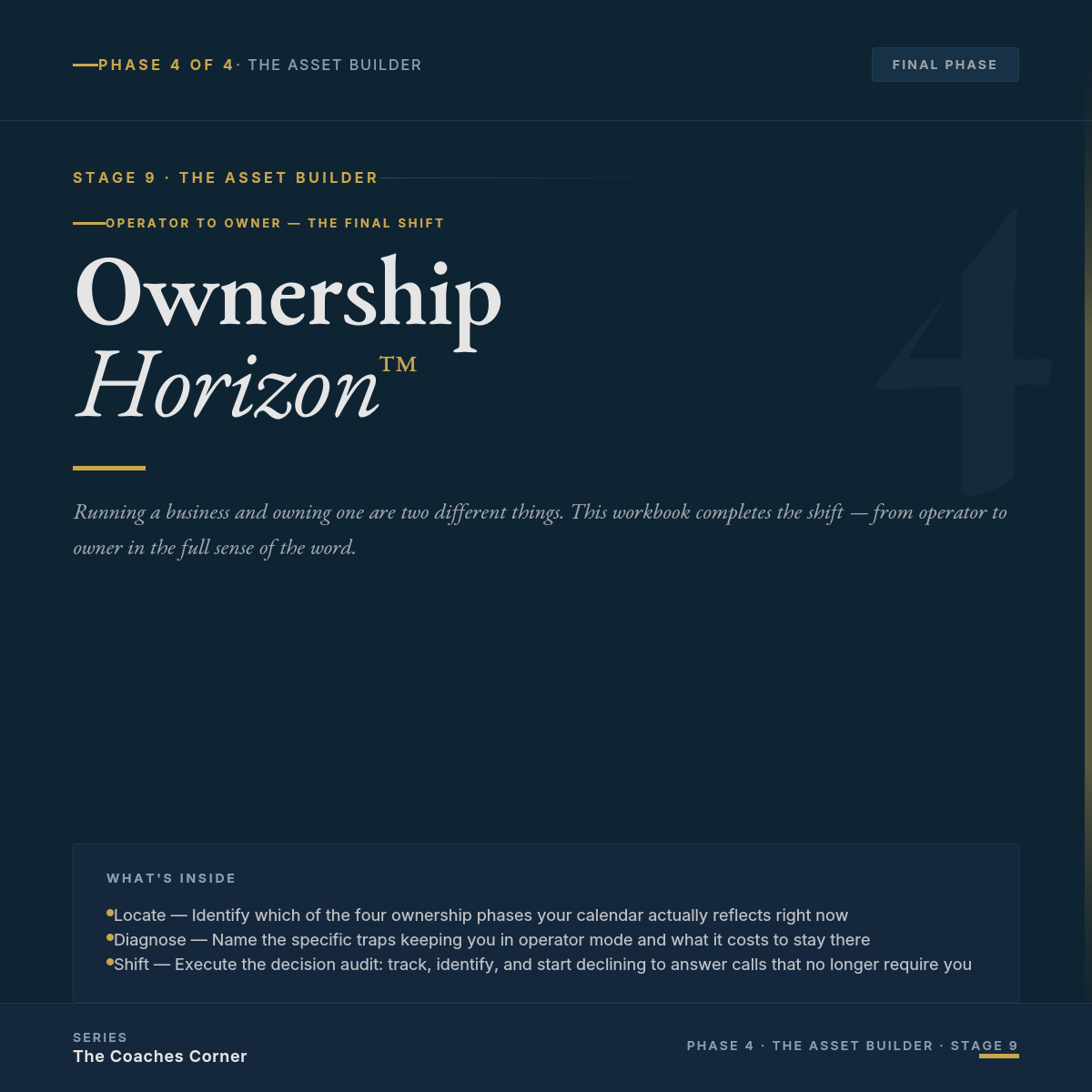
Phase 4 — Ownership Horizon™ Running a business and owning one are two different things. Most owners who feel they have largely made the shift are at Phase 3 on the ownership ladder — setting direction while others manage execution. The gap between Phase 3 and Phase 4 is often invisible until tested. Phase 4 is the test: a week-long decision audit that tracks every call made, identifies which ones the team could make, and starts the practice of declining to answer them. The week shrinks. The business does not.
Master AI Companion Prompt Guide All 28 prompts from across the series — 5 to 6 per phase covering diagnose, assess, build, and review — plus 3 universal prompts. Each phase includes a Review prompt designed for use at 30, 60, and 90 days. The gap between what was planned and what actually changed is where the real work is. Use those prompts on schedule.
Reviews
There are no reviews yet.